Our Home

Our Home

Tuesday, July 2, 2019

Walla Walla Circle Tour

After a busy Saturday working at the Museum at the Brig, we drove to Walla Walla, Washington, to begin a 4 day circle tour.
 
WHITMAN MISSION NATIONAL HISTORIC SITE
On Sunday morning we toured the Whitman Mission, one of the two major attractions in Walla Walla. We started our tour with a very well done 25 minute video in the Visitor's Center. The Whitmans, a missionary couple left their home in 1836 to travel the Oregon Trail, starting a Christian mission to convert the Cayuse Tribe. Marcus and Narcissa Whitman lived peacefully among the tribe for 11 years.  Rising tension over cultural differences and finally a measles outbreak, resulted in the execution of 14 settlers, including the Whitmans. Ultimately the Cayuse Tribe lost 90 percent of their population due to measles and smallpox. Today the tribe is a part of the Nez Perce.
Visitor Center and Small Museum
Whitman Memorial and Burial Site
 
FORT WALLA WALLA, WASHINGTON
The Fort Walla Walla Museum has an assortment of displays covering early pioneer life, farming, Lewis and Clark's Corp of Discovery, military history as well as Native American artifacts.
The Museum has 17 buildings and a pioneer village.
This full size 33 mule drawn state-of-the-art 1890 Combine was quite impressive.
Territorial Prison Display
 
PENDLETON, OREGON
In the northeast corner of Oregon, Pendleton's historic downtown has a glass-enclosed clockworks of the restored 1889 Seth Thomas Clock Tower.
 
PENDLETON WOOLEN MILLS
Pendleton is home to the Pendleton Woolen Mills, famous for producing high quality woolen goods and blankets since 1909. During the summer, factory tours are 4 times a day. We joined the 11 am tour.
The Factory Store
Spools of Wool Thread
Blanket Loom
Close up of the Loom
 
BLUE MOUNTAIN SCENIC BYWAY & THE SUMPTER GOLD DREDGE
We took a 70 mile paved scenic byway through the Blue Mountains from Ukiah to Baker City, Oregon.
Sumpter Valley Gold Dredge is located in the Blue Mountains, operated from 1935 through 1954. It mined more than $4,000,000 worth of gold, which just about covered the operation cost. The dredge path left hundreds of acres of disturbed land, mercury pollution, and rock tailings behind. Gold fever at its finest!
The dredge floated in 9 feet of water. It could go anywhere by taking its pond with it. As it dredged up rock and dirt, the pond filled its path. This looked to us like an EPA nightmare. This self guided tour state park site was similar to the one we toured at the Yankee Fork Gold Dredge in Idaho in 2015.
 
BAKER CITY, OREGON & NATIONAL HISTORIC OREGON TRAIL INTERPRETIVE CENTER
Baker City US Bank displays the 80.4 ounce Armstrong Gold Nugget
Located on Flagstaff Hill, just east of Baker City
US Bureau of Land Management Oregon Trail Interpretive Center was a modern museum and very well done.
The full size displays of pioneer life on the Oregon Trail, gives you a sense of being there.
Of the 2170 mile long Oregon Trail, only 300 scattered miles of wagon ruts remain.
 
HELLS CANYON/SNAKE RIVER VALLEY
Leaving Baker City and driving north we followed a scenic byway through the Wallowa Mountains to Joseph, Oregon, then on to Lewiston, Idaho. Part this drive follows the Snake River and the rim of the Hells Canyon National Recreation Area.
Hells Canyon National Recreation Area Overlook
Canola in bloom in the Palouse
View from our hotel balcony. Sunset over the confluence of the Snake River and the Clearwater River in Lewiston, Idaho.

Wednesday, May 29, 2019

Condoing in Seeley Lake, MT

The week before we started our volunteer jobs at the Museum at the Brig, we planned a one week condo trip in Seeley Lake, Montana. This is an area of Montana, northeast of Missoula and about 130 miles south of Glacier National Park, that we had not explored.
 
ARROWHEAD CONDOMINIUMS
The condominium complex has only 8 time share units. We felt very fortunate to be able to confirm this trade for a week before the busy summer season. We had a one bedroom unit that sleeps six. There was a full kitchen, master bedroom and a loft with two twin beds, laundry and a second bathroom. It was extremely clean and well appointed and we enjoyed a very comfortable week.
The deck off the living area overlooked the Swan Valley.
The Condo was located at an elevation of over 4,000 feet.
The condo provided cut and split wood for the fireplace insert.
We used it every evening, because the temperature dipped into the upper 30's.
 
HOLLAND FALLS HIKE
The three mile Holland Falls hike was well worth it.
Holland Lake had thawed out, but snow still covered the mountain tops.
Holland Lake
Holland Falls
 
GARNET GHOST TOWN
Garnet Ghost Town is located high in the Garnet Range. It was 35 degrees when we arrived. This was the seasonal opening day for this interesting BLM site. In addition to the ghost town, we followed the half mile Sierra Mine Trail to see remnants of mining operations along the hillsides bordering the town. We learned about "Placer" vs. "Load" mining and the brutal living and working conditions endured by the miners.
Gold was discovered here along Bear Gulch in 1865.
The town grew and prospered until about 1900.
Inside one of the 13 saloons. You could either mine the gold or mine the miners.
The last residents left Garnet in 1947.
This is one of the best preserved and top rated mining ghost towns in Montana.
 
LEE METCALF NATIONAL WILDLIFE REFUGE
We took off for a day trip south of Missoula. Our first stop was Lee Metcalf NWR. This 2800 acre NWR is cradled between the Bitterroot and Sapphire Mountain Ranges next to the Bitterroot River.
We took a couple of bird walks and stopped at the Visitor's Center, where there is a good collection of bird and mammal mounts.
 
FORT OWEN STATE PARK
This was the first permanent white settlement in Montana. It is also the location of the first Catholic Church, founded in Montana in 1841.
 
TRAVELERS' REST STATE PARK
This is the only site on the Lewis and Clark Trail where archaeological evidence has been pieced together confirming the Corp of Discovery encampment. The Corp's established this campsite in September 1805 on their way to the Pacific and camped here again on their return journey in 1806. 

At this point, on July 3, 1806, the Lewis and Clark Expedition left Travelers' Rest for the last time. Meriwether Lewis and nine men went north and east along the Blackfoot Valley to the plains and Missouri River. William Clark and the rest of the Corp set out to the south up the Bitterroot Valley and east exploring the Yellowstone River. After six weeks separation, both parties reunited on August 12 in North Dakota.
 
GUS, THE HUGE WESTERN LARCH
The world's largest Western Larch (aka Tamarack) tree is located in the Girard Grove, on the shores of Seeley Lake. This sixty acre natural grove of Western Larch was set aside by the Department of Forestry in 1953 in order to protect these large old trees. 
The Girard Grove
The Western larch is a large conifer. Unlike most conifers, it is deciduous. The needles turn golden in the fall and drop off.
The bark is thick and furrowed into flat ridges with overlapping plates.
The U.S. Champion Western Larch, named Gus, is over 1,000 years old.
The base measures 22 feet, 9 inch around.
The diameter is 7 feet, 3 inches at the base.
Gus is 153 feet tall. That's 2 feet taller than the Statue of Liberty.
 
THE MULLAN ROAD
At the top of 4th of July Pass along I-90 in Idaho is an interpretive trail commemorating the Mullan Road. We have driven past it many times and this time we stopped to check it out. This section of the Mullan Road is just a remnant of the 624 mile road designed to connect the head of the navigation on the Missouri River (Fort Benton) with the Columbia River (Fort Walla Walla). The 25 foot wide road was constructed between 1859 and 1862 at a cost of $400 per mile. This was a very important route until the railroad was constructed 1882. Much of the Mullan Road is now under the interstate highway.
A fond farewell to Seeley Lake as we passed this beautiful view of nearby Salmon Lake.

Thursday, May 16, 2019

Traveling to North Idaho

Leaving McKinney, Texas, on April 30 we drove fast across the plains states to avoid severe weather.
 
SCOTTS BLUFF, NEBRASKA
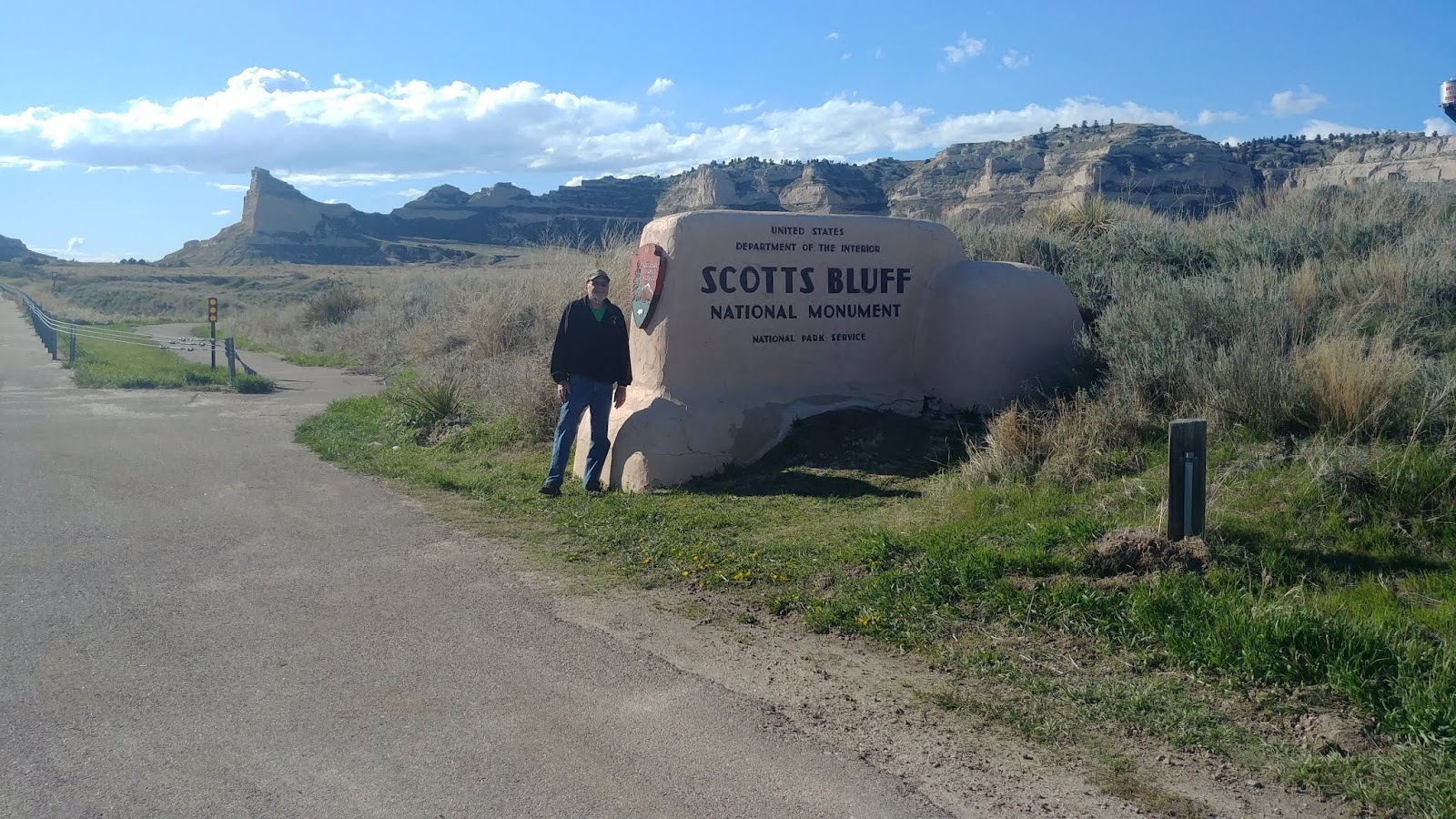
Several times we have driven past the turn-off to Scotts Bluff National Monument. This time we took the 23 mile detour to check it out. This sandstone and siltstone bluff sits just north of the North Platte River in far western Nebraska.
The Scotts Bluff visitor center sits at the entrance to the road to the top of the bluff. The visitor center was closed for remodeling, but there was a temporary trailer with staff to help as well as an orientation film.
Scotts Bluff was a beacon in the prairie flatland for the wagon trains and cattle drives of the old west.
The road to the summit was built in the 1930's by the Civilian Conservation Corp. Trailers and motor homes aren't allowed because there are three tunnels cut into the bluffs.
The morning was clear and dry. We could see Chimney Rock National Historic Site in the distance. It was hard to believe a storm system was moving in that afternoon. So another day of driving with not a day to rest. 
From the top of the bluff you could see the visitor center below along with one of the tunnels.
 
NEW SHOES FOR THE 5'er
It's hard believe our trailer is five years old and time for new tires all the way around. Having spent the night in Hermosa, SD, we arrived at the Truck Center in Rapid City at 7:30 Saturday morning. We got truck tires here last year and really liked this dealer, so our plan was to stay in the Rapid City for a long weekend to replace them at our leisure.
We used our hydraulic jacks to lift up the frame. The workers really liked that.
Floor stands were placed under the axles just for safety.
We replaced the tires with the same as factory originals.
Goodyear 17.5" Load Range H/16 ply 
After the tires were replaced, rain and snow was catching up with us. We moved on that afternoon heading west on I-90 for a planned stop in Sheridan, Wyoming.
 
WELCOME TO IDAHO
After stops in Sheridan, WY, and Deer Lodge, MT, we arrived at Farragut State Park on Monday, May 6.
 
We reset our watches to Pacific Time for the summer at the Idaho State Line.
Our site was ready for us, just a little cleanup of pine needles.
We put out the feeder hours after our arrival and our friends the humming birds were waiting, very impatiently. The Calliope and Black Chinned drink about a cup a day.